The quick order to use when several debts compete
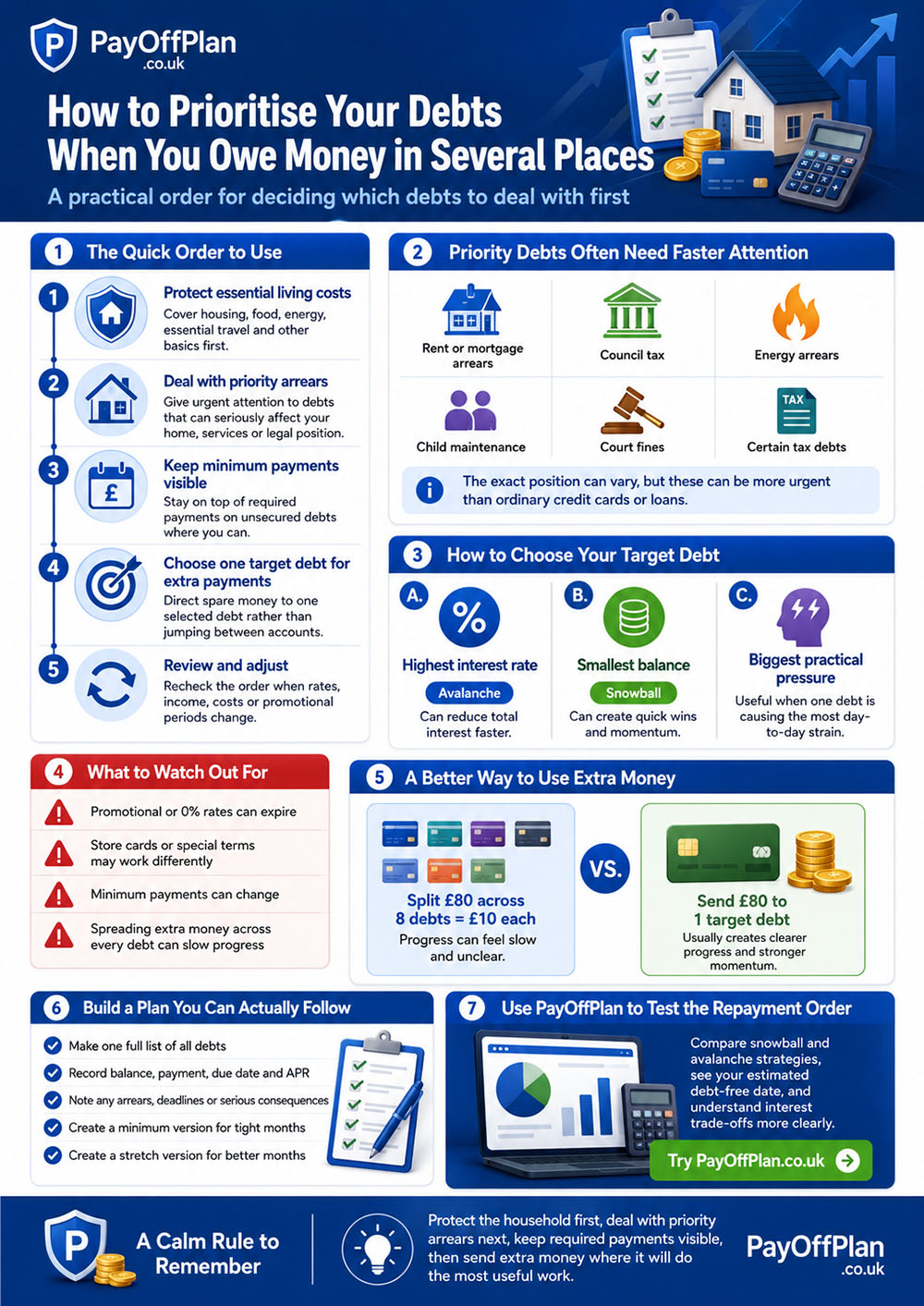
If you are trying to prioritise debts, separate survival, obligation and optimisation. Survival means food, housing, energy, essential travel and other basic costs. Obligation means priority bills and arrears where missing payments can have serious consequences, such as rent or mortgage arrears, council tax, energy arrears, child maintenance, court fines or tax. Optimisation means deciding which ordinary unsecured debt should receive extra payments once the rest of the plan is stable.
A practical order is simple: cover essential costs first, deal with priority arrears next, pay at least the contractual minimum on each unsecured debt where you can, then direct any spare repayment money to one chosen target debt. That final target might be the highest interest rate, the smallest balance or the debt causing the most practical difficulty. The best choice depends on your numbers and on what you can keep doing month after month.
This matters because not all debts create the same risk if they are left unpaid. A credit card charging a high APR can be expensive, but rent arrears or missed council tax can create more immediate pressure. A good repayment order recognises both: it protects the household first, then reduces the total cost of debt where possible.
Start by sorting debts into useful groups
Before choosing which balance to attack, make a full list of everything you owe. Include credit cards, overdrafts, loans, store cards, buy now pay later balances, money owed to family or friends, arrears on household bills and any formal repayments already agreed with creditors. Put the list in one place so you are not trying to make decisions from memory.
For each debt, record the current balance, the regular payment due, the due date, the interest rate or APR if you know it, whether the rate is fixed or promotional, whether you are behind, and what could happen if you do not pay. The consequence column is often the part people miss. It is also the part that stops a plan from being purely mathematical when the real issue is household stability.
Once listed, group the debts into three broad categories: essentials and priority commitments, contractual minimum payments on unsecured debts, and optional overpayments. This stops an overpayment to one creditor from accidentally taking money away from a more important bill. It also helps you see whether you have a repayment strategy problem or an affordability problem.
Protect essentials before making extra debt payments
Extra payments can shorten a repayment plan, but they should not come from money needed for rent, mortgage payments, food, energy, prescriptions, essential travel, childcare or other basic commitments. If overpaying a credit card means you cannot cover the weekly shop or the next energy bill, the plan is not working, even if the spreadsheet looks efficient.
A realistic repayment plan leaves enough room for ordinary life. That does not mean every expense stays untouched. It means you distinguish between optional spending that can be reduced and essential costs that must be protected. People often abandon debt plans because they are too tight, not because they do not care about becoming debt-free.
If there is not enough money to cover essentials and required payments, pause the idea of choosing a debt to overpay. At that point, free, qualified debt advice may be more useful than a standard accelerated repayment method. A debt adviser can help you look at the full situation, including arrears, creditor contact and options that depend on your circumstances.
Deal with priority arrears before ordinary unsecured debts
Priority debts are not always the biggest debts or the ones with the highest interest rate. They are debts where the consequences of falling behind can be more serious for your home, essential services, legal position or day-to-day life. Examples can include rent or mortgage arrears, council tax, energy arrears, child maintenance, court fines and certain tax debts.
The exact position can vary by where you live in the UK, the type of debt and the stage the creditor has reached. The safe principle is to recognise that some arrears need attention before ordinary credit cards, personal loans or overdrafts. If a creditor has sent court papers, a possession notice, enforcement letters or disconnection warnings, do not treat that as just another item in the repayment queue.
This does not mean unsecured debts are unimportant. It means you should not send all spare money to a store card while ignoring rent arrears, council tax arrears or a court fine. If you are unsure whether a debt is priority, check with a reputable free debt advice provider before deciding how to divide payments.
Keep minimum payments visible, not hidden
When you have several credit cards, loans or other unsecured debts, each one may have its own minimum or contractual payment. Those payments are the base layer of the plan. If you can afford them, keep them visible in your budget before deciding where extra money goes.
A common mistake is to focus on one debt so intensely that another payment is missed by accident. That can create fees, interest, arrears, creditor contact and stress, even if the target debt is falling quickly. A focused strategy does not mean ignoring the rest. It usually means paying the required amount on every other debt, then putting the extra towards the selected target.
Minimum payments can also change. Credit card minimums may be based on a percentage of the balance, a fixed minimum amount, interest and fees, or the lender's own formula. Loans may have fixed instalments. Overdraft costs may work differently again. Use the actual payment each creditor expects rather than assuming every debt behaves the same way.
Choose a target debt for extra payments
Once essentials, priority arrears and minimum payments are covered, you can decide where any extra repayment money should go. There are three sensible ways to choose the first target: by interest rate, by balance size or by practical pressure.
Targeting the highest interest rate is often called the avalanche approach. The logic is mathematical: every pound sent to a higher-rate balance can reduce future interest more than the same pound sent to a lower-rate balance, assuming the debts and rates behave as expected. This can be a strong method when the numbers are clear and you can stay motivated even if the first balance takes a while to disappear.
Targeting the smallest balance first is often called the snowball approach. The benefit is psychological and practical: clearing one account creates a visible win, reduces the number of payments to manage and frees up a payment that can be rolled into the next debt. It may not always minimise interest, but it can be easier to stick with for someone who feels overloaded by too many accounts.
Targeting practical pressure means choosing a debt because it is creating a specific problem, even if it is not the smallest or highest-rate balance. For example, an overdraft used every month might make your income feel swallowed as soon as it arrives. A family loan might be creating relationship strain. A credit account near its limit might be making the whole plan feel fragile. These factors are harder to express in a formula, but they can still matter.
Compare interest cost with motivation
A repayment order that saves the most interest is attractive, but only if you can keep following it. A repayment order that feels motivating is useful, but it still needs to fit the cost of the debts. The strongest plan is often the one that balances both.
Imagine three unsecured debts: a credit card balance of £2,400 at 24% APR, a store card of £450 at 19% APR and a personal loan of £3,200 at 8% APR. If you have £100 extra each month after all required payments, the highest-rate credit card is likely to be the interest-led target. The smallest-balance store card is likely to be the momentum-led target. The personal loan may be lower priority for extra payments if the payment is fixed, the rate is lower and there are no arrears, although the terms still matter.
Neither answer is automatically wrong. If the credit card interest is eating into progress and you can tolerate a longer wait for the first cleared account, prioritising it may make sense. If closing the store card quickly would reduce mental load and help you stay engaged, that may be the better first step. The important part is making the trade-off deliberately, not drifting from one creditor to another each month.
Be careful with promotional rates and special terms
Interest rates are not always as straightforward as they look. A balance transfer card may have a 0% promotional period followed by a much higher rate. A store card may have deferred interest rules. A loan may include early repayment restrictions or a fixed schedule. An overdraft may charge interest daily and feel hard to reduce if new spending keeps passing through the account.
This is why prioritisation should use current terms, not labels. A 0% balance might not be urgent today, but it could become important if the promotional period ends soon and the follow-on rate is high. A lower-rate debt might still need attention if the payment is unaffordable or if arrears are building. A high-rate balance might be less urgent than a priority arrears problem that threatens your housing or essential services.
If you are unsure how interest is calculated, look at the credit agreement, the latest statement or the online account. Pay attention to whether interest is annual, monthly, daily, fixed, variable or promotional. A debt calculator can help you compare repayment scenarios, but the result is only as useful as the information you enter.
Avoid spreading extra money too thinly
Splitting spare money across every debt can feel fair, but it often slows progress because no single balance changes much. If you have £80 extra and divide it across eight debts, each account receives £10. That may be better than doing nothing, but it may not create a visible result, reduce interest meaningfully or simplify the number of accounts quickly.
A focused approach usually works better: maintain the required payments everywhere else, then send the extra to one target debt until there is a reason to switch. When that debt is cleared, redirect its old payment and the extra amount to the next target. This is how momentum builds without increasing the total monthly amount.
There are exceptions. You might split extra money temporarily if two debts both have urgent deadlines, if a promotional rate is about to expire, or if you are catching up small arrears across essential accounts. But as a long-term method for ordinary unsecured debts, spreading every spare pound evenly can make the plan harder to measure and easier to lose faith in.
Build a priority list you can actually follow
A useful priority list is specific enough to guide the next payment. It might say: pay rent, council tax, energy and food first; keep all contractual minimum payments up to date; send the extra £75 to the credit card at 24% APR; review the order when that balance is cleared or when the 0% card has three months left on its promotional period.
Notice that this kind of list includes review points. Debt priority is not a one-time decision. It can change when a balance is cleared, an interest rate changes, income drops, essential costs rise, a promotional period ends or a creditor agrees a new arrangement. A good plan is stable enough to follow but not so rigid that it ignores new information.
If your income varies, build the list around minimum and stretch versions. The minimum version says what must be paid in a tight month. The stretch version says where extra money goes in a better month. That reduces the temptation to abandon the whole plan when one month does not match the ideal forecast.
Use PayOffPlan to test the repayment order
Once you have listed your debts, PayOffPlan can help you compare how different repayment orders may affect your estimated debt-free date and interest. This is particularly useful when the choice is not obvious, such as a small high-rate balance against a larger balance with a promotional period.
Enter the balances, rates and payments as accurately as you can, then compare a snowball-style order with an avalanche-style order. Treat the result as an estimate, not a promise. The projection can change if payments change, interest rates move, fees are added, new spending appears or a creditor calculates interest differently.
The value is not only the final date. It is the clarity you get from seeing the trade-off. If one strategy is only slightly cheaper but feels much harder to maintain, that is useful information. If the interest difference is large, that is useful too. A plan becomes easier to trust when you can see why you chose it.
Questions people ask when choosing debt priority
Should I pay the smallest debt or the highest interest debt first?
After essentials, priority commitments and minimum required payments are covered, the smallest debt can be useful for motivation, while the highest interest debt may reduce interest costs. The right choice depends on your balances, rates, payments and what you can keep doing consistently.
What if I cannot afford all my debt payments?
If you cannot cover essential living costs, priority commitments or contractual minimum payments, a normal overpayment strategy may not be suitable. It is usually sensible to seek free, qualified debt advice before deciding which creditors to pay extra.
Can I split extra money between several debts?
You can, but splitting extra money can slow visible progress because no single balance falls as quickly. A focused approach is often clearer, provided minimum payments continue on the other debts and the chosen priority fits your wider situation.
A calm way to choose your next payment
If several debts are asking for attention, do not start with guilt or guesswork. Start with order. Protect the household, identify any priority arrears, keep required payments visible, then choose where extra money will do the most useful work. That might mean reducing interest, clearing a small balance or removing a debt that creates practical pressure.
The aim is not to find a perfect order that never changes. The aim is to make the next few payments clear enough that you can act without rethinking the whole situation every time money arrives. Debt repayment is easier to sustain when every pound already has a job.